

This is a transcript of the keynote address given at the Equipped to Welcome and Belong conference 2026, organised by Welcome Churches and Mission Action Partnership.
For those of you who don’t know, before I began ministry, I was an English teacher. And so, it probably won’t surprise you that I’ve always had a fascination with words.
So, if you are patient with me for a moment, I’d like to geek out on a word that has occupied my attention for the last couple of weeks.
There will be a point. I promise…
It’s a word we don’t hear very often these days.
The word is kin.
As you’ll know, it’s usually taken to mean family—your kinsfolk. But really it’s stronger than even that. It speaks of a people who share the same origin—who are bound together, despite all other differences, by the same blood, the same story.
Now, here’s the geeky bit… Kin is one of the oldest words in the English language. In fact, it’s even older than modern English.
It appears in the Old English as cynn.
But its lineage goes back even further—through early Germanic languages, where we find the word kunją.
And further still—several thousand years—to an ancient Indo-European root, ǵenh—meaning “to give birth” or “to beget”.
Now, if you’re still with me, maybe you have guessed at the point of this etymology lesson… ǵenh is the same ancient root that lies behind the name of the first book in the Bible—Genesis.
And that seems to me to be entirely appropriate.
Because the theme that begins in Genesis—and that runs through the whole Bible—is kinship… family.
It begins not only at creation, when God forms one humanity in his image, but takes a decisive turn when God calls a particular person, from a particular place, and makes a promise: through this family, all the families of the earth will be blessed.
And, then, if we skip ahead to the very end of the Bible—and to that extraordinary vision of Revelation 7—we discover that this family includes people of every ethnicity.
Let me read it with you:
9 After this I looked, and there before me was a great multitude that no one could count, from every nation, tribe, people and language, standing before the throne and before the Lamb. They were wearing white robes and were holding palm branches in their hands. 10 And they cried out in a loud voice:
“Salvation belongs to our God,
who sits on the throne,
and to the Lamb.”
That’s the gospel in full technicolour, isn’t it? A new creation. A redeemed and gathered people, worshipping together. One family made up of many nations.
This morning, I want to remind you how the entire arc of Scripture curves towards this moment, when God’s kingdom will come, on earth as it is in heaven.
But more than that, I want to convince you that:
“The huge multicultural gathering of Revelation 7 is not meant as a vision simply for the ultimate future. It is to be reflected in actual worshipping communities here and now.”
These are not my words. They are the words of Tom Wright, in his new book God’s Homecoming. And he goes on to argue that the local congregation has a vital part to play in bringing God’s technicoloured future into the present.
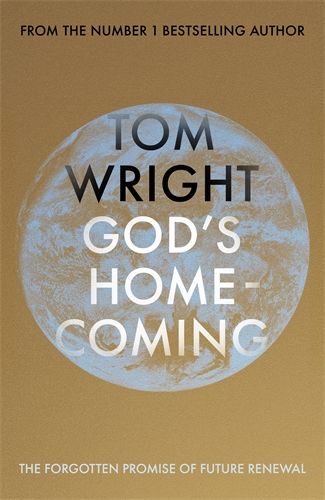
He describes the local church as a kingdom outpost.
I love this image. The church as an outpost of God’s coming kingdom—a forerunner of God’s new humanity.
But, as much as I love the metaphor, it seems to me that the word kingdom needs careful parsing in our cultural moment.
When the cross of Christ is being carried in “Unite the Kingdom” marches, we need to state clearly what the kingdom of God is not. That it is not a euphemism for nationalist movements. That it is not something that can be co-opted for political ends, whether of the Left or the Right.
We need to proclaim loud and clear the vision of Revelation 7, that God’s kingdom is not monochrome—it is multicoloured.
It is (to return to that word I have been geeking out on) a kin-dom—a radical knitting together of every ethnicity and culture in worship of the Lamb of God, who takes away the sins of the world.
Such a kin-dom is not going to be achieved by marches, or any political movement. It will only be achieved by the work of God’s Spirit.
That’s why I believe the local church has such a vital role to play in current debates around immigration.
Right now our society needs a better story.
Those who co-opt the gospel for a nationalist agenda need their imaginations baptised into a bigger gospel—they need to be reminded of the beauty of Revelation 7.
And those who champion diversity and inclusion—from whatever starting point—need to be presented with a more compelling vision. They need to see a unity deeper than anything the secular world can offer.
What I am saying is that our society needs a better story on multiculturalism.
And the churches have that story to tell.
So, here’s the big idea I want to explore with you today. Maybe I can sum up it up in one clear sentence:
If God’s purpose is to gather the nations into one family in Christ, then the Church is called to live that future into the present.
In other words, we must strive to be a multiethnic church, because in this way we will be what the church was always intended to be—the living embodiment of God’s good future.
So, to help us explore that, we’re going to lean in a little bit more into what Scripture says. And as much as I would love to take the rest of this morning to trace that incredible arc from Genesis to Revelation—uncovering all the ways this promise of God is whispered in the story of Israel, proclaimed in the ministry of Jesus, and enacted by the church in Acts—we simply don’t have time.
For that, I recommend Wright’s book.
Instead, I want to focus in on a passage of Scripture that seems to me to tie all these threads together. I’d like us to turn to Paul’s words in Ephesians 3, where he unpacks the implications of this vision for Christ’s church.
But before we dive in—maybe we need a quick reminder of where these verses sit in the letter.
In particular, what we read in Ephesians 2, which presents us with perhaps the most compelling vision of Christ’s multiethnic church in the entire Bible.
Paul describes with such power and clarity how Christ’s reconciling work on the cross has broken down the old walls of hostility between Gentile and Jew, so that though the Ephesians were once foreigners and strangers, now they are fellow citizens with God’s people and members of his household.
It’s amazing language. And he goes on to urge them to recognise this new reality, that in Christ they are being built together into a dwelling place for God (or, to pick up our earlier language, for the church to be the preparation for God’s homecoming…)
And so, when we turn to chapter 3, it is all this that Paul has in mind as he spells out the implications of this new humanity in Christ. What did it mean for the church in Ephesus? And what does it mean for churches in Northern Ireland?
To give you a break from my voice, my wife Emma is going to read Paul’s words for you. You will be able to follow along on the screen.
It’s not the most accessible passage in Paul’s writings. The language is loaded and the phrasing a little complicated at times. So to make it a bit easier, I want you to pay close attention to a word Paul uses repeatedly—mystery.
What is this mystery he is referring to? How has it been uncovered? And what does it mean for the church then and now?
This is the reason that I, Paul, am a prisoner for Christ Jesus for the sake of you gentiles, 2 for surely you have already heard of the commission of God’s grace that was given me for you 3 and how the mystery was made known to me by revelation, as I wrote above in a few words, 4 a reading of which will enable you to perceive my understanding of the mystery of Christ. 5 In former generations this mystery was not made known to humankind, as it has now been revealed to his holy apostles and prophets by the Spirit: 6 that is, the gentiles have become fellow heirs, members of the same body, and sharers in the promise in Christ Jesus through the gospel.
7 Of this gospel I have become a servant according to the gift of God’s grace that was given me by the working of his power. 8 Although I am the very least of all the saints, this grace was given to me to bring to the gentiles the news of the boundless riches of Christ 9 and to make everyone see what is the plan of the mystery hidden for ages in God, who created all things, 10 so that through the church the wisdom of God in its rich variety might now be made known to the rulers and authorities in the heavenly places. 11 This was in accordance with the eternal purpose that he has carried out in Christ Jesus our Lord, 12 in whom we have access in boldness and confidence through faith in him.
As I said, there’s a lot going on here.
But did you notice that word mystery?
Because it’s understanding what Paul means by mystery that pulls together all the threads of Scripture to reveal God’s full technicolour gospel.
And to understand why this was a mystery to Paul, it might be helpful to put ourselves in Paul’s shoes for a moment.
Let’s remember that he was a Pharisee, who prided himself on being an expert in the Law.
Paul knew his Scriptures inside and out. He knew the promises of God to his people—and he believed that in persecuting the followers of the crucified Jesus he was being faithful to those promises.
And those promises were not a mystery in his mind—they were clear. God had chosen to bless the family of Abraham. In other words, the promises of God were exclusive to him and his kin.
Or, at least, that’s what he thought.
But we know how the story goes. We know how Paul’s encounter with the Risen Christ on the Road to Damascus caused him to see again.
And in the months that followed, when he took himself away to study again the Scriptures, he found himself looking with new eyes.
Suddenly, more colour started seeping into the story, as he began to see what was hidden in plain sight—that God’s promise to Abraham was so much bigger than anything Paul had imagined.
And, now, with the light of Christ’s revelation, Paul is able to see the full extent of this promise—the mystery revealed in verse 6: that the gentiles have become fellow heirs, members of the same body, and sharers in the promise in Christ Jesus through the gospel.
All the nations, one family in Christ.
And with this mystery uncovered, Paul is given a new urgency. As Saul he was driven to preserve what he believed to be the narrow scope of the promise; as Paul he has a new fire in his belly to live into the wide scope of the gospel of Christ—going to the very ends of the earth with the gospel of reconciliation to all people.
And that’s where this passage now turns, with words that I really want us to grasp today.
Because Paul makes the incredible claim that it is through the church the wisdom of God in its rich variety is made known. And made known to the rulers and authorities in the heavenly places—that is, the principalities and powers of this world.
So, Paul is clear: it is the calling of the church to embody, to reveal, to celebrate before the world and its powers the full technicolour glory of Christ’s new body—one family made up of many nations.
That’s the charge to us. That’s the calling.
And a calling that should give us the same fire in our bellies as the Apostle Paul.
If that’s true, then we in the churches have work to do.
So, as I try to pull all this together, let me share just two ways Paul’s words have challenged me. And I want to centre what I want to say around two words: unity and courage.
Unity
I mentioned Tom Wright earlier. On a recent podcast promoting his new book, he answered a question in a way that has really got me thinking.
Asked what he thought would most trouble the Apostle Paul about the modern church, his answer was clear—their disunity.
In Northern Ireland, that’s certainly something we need to hear. But reading Wright’s book, I have been struck that there is a more blatant disunity among the churches across the world that goes largely unnoticed.
Because while we might think of disunity in terms of doctrinal issues or denominational differences, the most obvious and pervasive sign of disunity in our churches is ethnicity.
Wright calls this the problem of the monochrome church.
I confess, I have spent much of my life oblivious to this. But that’s the great weakness of the monochrome church—you can’t see it when everyone else on a Sunday looks like you.
It’s only apparent when you are in the minority.
When did the technicolour church of the first centuries get drained of its colour?
And why is it that we have been largely okay with this?
When did the technicolour church of the first centuries get drained of its colour? And why is it that we have been largely okay with this?
Now, I know there will be all sorts of sociological reasons why our towns and cities end up with churches of different ethic groups—Nigerian churches, or Chinese churches, or whatever it may be.
And I understand that these churches will be doing an amazing job at showing Christ’s hospitality and welcome.
But their existence only highlights how much the established churches failed to show to show welcome, or to rejoice that the vision of Revelation 7 is taking shape among us!
I don’t know about you, but it seems to me that the early church was much better at this than we are. I mean, would a Parthian moving to Ephesus in the first century go looking for the local Parthian fellowship? Absolutely not!
No, the early church was technicoloured. It posed such a radical witness in the ancient world because it cut through ethic differences, as much as it cut through class, and gender, and nationality.
Now, of course, this is not so say that unity means uniformity. The vision of Revelation 7 is of the nations—in all their rich variety—worshipping the Lamb. But the good news of Jesus is that in worship of him we find all other distinctives become secondary.
We find real unity, in our diversity, through our union with Christ.
So, that’s the first challenge: unity.
Finally, and very briefly, courage.
What we have discovered this morning is that the call to a multiethnic church is not optional—it is a divine imperative.
Christ has demolished the separation walls; he does not want us to build them back up.
And so, as the cultural landscape of Northern Ireland changes, we must not see this as a threat but an opportunity to more courageously live in to that Revelation 7 future.
I fully recognise that this can be scary for people. We see this fear taking hold across society in all sorts of ways.
But as I finish, I want to reflect a little on the courage that is needed in a local context. And I want to do that by sharing very briefly the journey we are on at Newtownbreda.
I have been ministering at St John’s for not much more than two years. But even in that short time we have witnessed significant change as we have been joined by many families from Hong Kong and other places across the world.
Ours is a congregation in the midst of what we believe is a season of renewal. We are a traditional, Presbyterian congregation, that is adapting to reflect better the diverse community of South Belfast.
As the minister, I have been encouraged and humbled by the grace shown by both the established congregation—many of whom have worshipped in the church for generations—and the newcomers among us.
The established congregation has shown extraordinary welcome and openness to change; the new members have been proactive and hospitable in integrating.
I don’t know of anyone at Newtownbreda who does not delight at this renewal. It is an answer to prayer for a congregation which, like so many established churches in Belfast, has grappled with decline.
But that collective joy poses a challenge. Because the great temptation is to think, Great! People are coming back to church! Newtownbreda as we have known and loved it has a future!
That’s an understandable response—to continue as we have always done. That we expect new members to adapt to our way of do of things, without the openness to how God might grow us together.
But more of the same is not the vision of Revelation 7. And it’s not what Paul means when he tells us that in our little community of believers on the Ormeau Road the wisdom of God is made known.
I am coming to realise that what we need in our local context—and what the gospel calls us to—is courage. Courage to be open to the ways in which God will grow and shape his body at Newtownbreda into something new—something more faithful to the Revelation 7 vision.
In the coming years the culture of our congregation will change.
God willing, we will more and more reflect the community in which we live and to which we are called to witness together to the gospel of Jesus Christ.
And not in monochrome. But in full technicolour.
And perhaps this is where I come back to that word I began with—kin. A people who share an origin. A people who are bound by a story. A people who are living towards the same future.
In a world that is so fractured and divided along every line, we are called to be citizens of the kin-dom of God.
And if that is true—then the question is not simply whether we are welcoming the newcomer, but whether we are becoming the church God is calling us to be.
One family. In full technicolour. Gathered around the Lamb.